
Joshua K. Leon is a writer, and Professor of Political Science and International Studies at Iona University. He was awarded the 2022-23 Robert David Lion Gardiner Fellow at New York Historical to research his forthcoming book, New York, 1860.
A doctorate in Political Science, he writes on urban history, international relations, and development. He has recently written for venues including The Chicago Tribune, The Progressive, Dissent, Journal of Cold War Studies, Journal of Urban History, Third World Quarterly, Planning Perspectives, City, Metropolis, Peace Review, The China Beat, Cities, Brooklyn Rail, Monthly Review, The Normal School, Asia Times, Arch Daily, Foreign Policy In Focus, Urban Omnibus, Next City, and Cambridge Review of International Affairs. He has also taught at Villanova, Temple and Drexel Universities. He lives in Manhattan.
New York Public Library profiles my recent research here.
**New York, 1860 is coming in January from Columbia University Press. Pre-order here. Publisher’s information here. On life in New York on the brink, here.
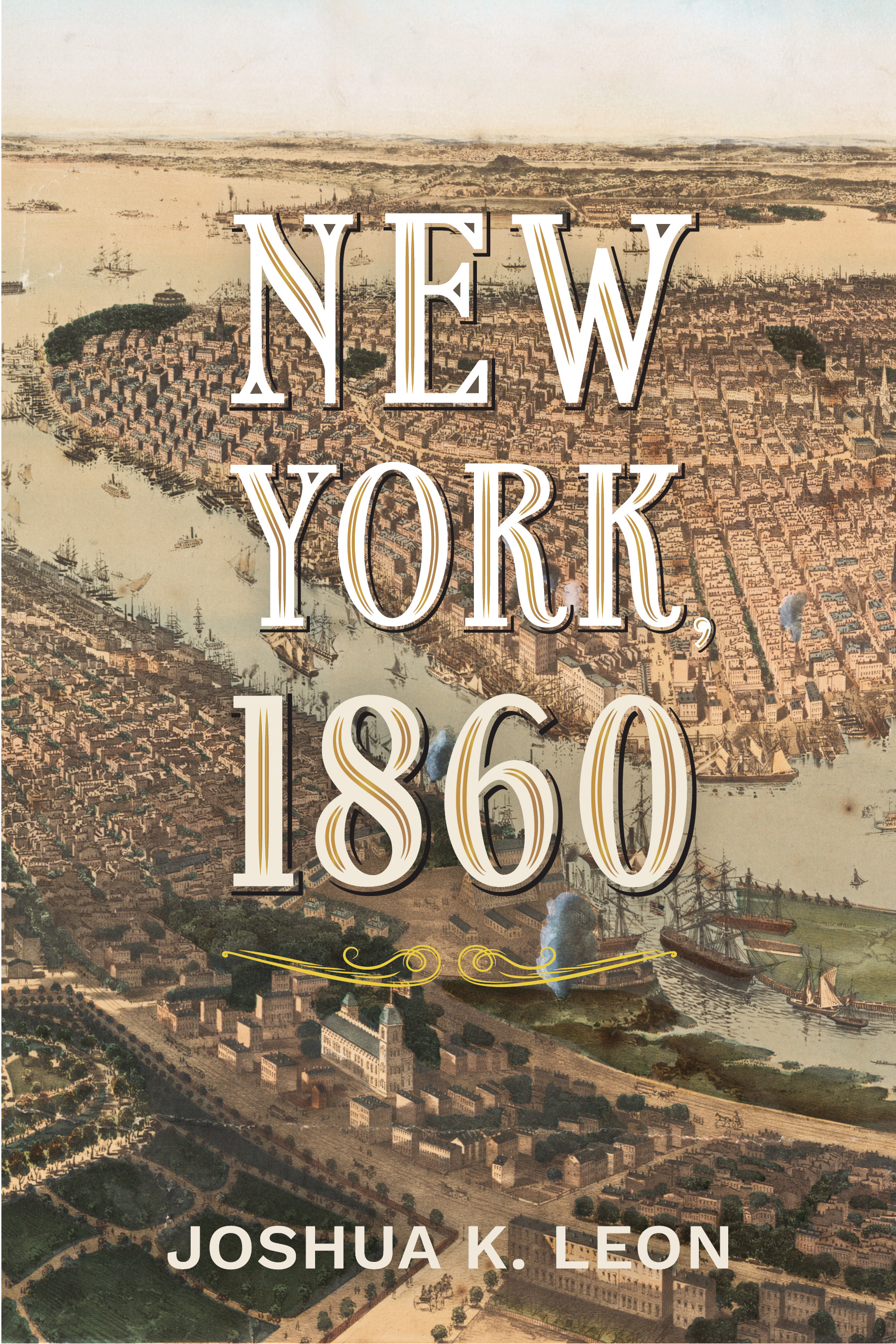
“Year of meteors! brooding year!” wrote Walt Whitman about the year 1860. New York City was a tinderbox. As the country’s trading capital, the city was caught in an unholy alliance with slave-owning cotton planters. Southern sympathizers—the mayor among them—shared the streets with abolitionists like Henry Ward Beecher. Abraham Lincoln began his unlikely march to the presidency in a speech at Cooper Union, and torch-bearing militiamen marched for him while merchants and secessionists organized against him. The city was a place of parades, séances, human trafficking and slavecatching, quack cures, dire poverty, and political fervor, hopelessly riven by the looming presidential election.
This book is a biography of New York City in the year before the Civil War, from the moment the telegraph brought news of John Brown’s raid on Harper’s Ferry in October 1859 to the first shots on Fort Sumter in the spring of 1861. Joshua K. Leon tells this story month by month through the eyes of those who lived it, weaving together the intersecting lives of the giants of the age, forgotten celebrities, and the everyday people in the city’s swelling crowds: the obsessive diarist George Templeton Strong, the “Queen of Bohemia” Ada Clare, the journalist Thomas Butler Gunn as he goes undercover in the secessionist South, the showman P. T. Barnum and his American Museum in downtown Manhattan, the frustrated actor John Wilkes Booth, and many more. New York, 1860 recovers lives led in the shadow of catastrophe, capturing the dreams, romances, laughter, and fears of New Yorkers as history bore down on them. In vivid detail, this book brings their city to life in all its filth and glory.
He spoke on the project, midway through researching it, at New York Historical.
Reviews:
“If 1860 was the pivotal year that changed America, then New York was the city that defined 1860: a roiling, divided, metropolis where the very rich wanted more, the very poor demanded opportunity, and the political class battled for power as the nation faced disunion. Joshua Leon has crafted a lively, engrossing, and deeply informed account of the country’s largest urban center. Here is New York as a financial and cultural center filled with extraordinary personalities and thriving commerce masking both economic and racial inequality. Leon places a cast of dazzling characters, both famous and unknown, against the backdrop of unbridled ambition, broken dreams, crowded streets, bustling docks, thronged theaters, and fetid slums. This is a dazzling literary and historical achievement.” Harold Holzer, author of Lincoln at Cooper Union and Manhattan Borough Historian.
“The crisis of the Union seen from New York City, told with a breaking-news sensibility. The monied interests, the Irish laborer, the tarred-and-feathered reporter, the poet, the scheming mayor: Leon’s book brings it all vividly to life.” Stephanie McCurry, author of Women’s War: Fighting and Surviving the American Civil War
“Josh Leon’s New York, 1860 is as multifaceted, dynamic, and compelling as the city it portrays. Through remarkably detailed research, Leon immerses readers into the daily lives of a wide variety of New Yorkers, each navigating the complexity and cacophony of a city undergoing tremendous upheaval and on the precipice of war.” Alexander Manevitz, author of Seneca Village: A Story of Black Freedom and Manhattan Real Estate
“This extraordinary book makes urban social history and Civil War history remarkably accessible, tangible, and personal. The life of an impressive range of historical characters—journalists, athletes, actors, activists, artists, politicians, scoundrels, and astute observers—comes into focus through the author’s unique storytelling style.” David N. Gellman, author of Liberty’s Chain: Slavery, Abolition, and the Jay Family of New York
“Across fifteen beautifully crafted and meticulously researched chapters, Leon reveals untold but vitally important stories about a stunning range of city residents, from iconic figures such as Walt Whitman and infamous mayor Fernando Wood to lesser-remembered figures like activist Elizabeth Jennings and actress Adah Isaacs Menken. Along the way, hundreds of other New Yorkers join the ensemble and, in Leon’s hands, they spring to life to recreate a long-forgotten world.” Jonathan Daniel Wells, author of The Kidnapping Club: Wall Street, Slavery, and Resistance on the Eve of the Civil War
“In the months just before the Confederate attack on Fort Sumter, New York City was already at war with itself. Democratic politicians openly advocated secession should a Republican capture the White House. Others packed the seats at Cooper Union to hear Abraham Lincoln, while nearby the city’s Black community organized against slave catchers and lobbied for voting rights. With a novelist’s eye for illuminating detail, Joshua K. Leon brings these turbulent months to life. A rich and lively account of the men and women, Black and white, affluent and poor, who called Manhattan their home.” Douglas R. Egerton, author of A Man on Fire: The Worlds of Thomas Wentworth Higginson

**World Cities in History is available to order here.
Joshua K. Leon’s most recent book is called World Cities in History: Urban Networks From Ancient Mesopotamia to the Dutch Empire, from Cambridge University Press. It has been called “the definitive worldwide analysis of pre-industrial cities.” World Cities in History explores 6,000 years of urban networks and the politics that drove them, from Uruk in the fourth millennium BCE to Amsterdam’s seventeenth-century ‘golden age.’ It provides a fresh, interdisciplinary reading of significant periods in history, showing how global networks have shaped everyday life. Alongside grand architecture, art and literature, these extraordinary places also innovated ways to exert control over far-flung hinterlands, the labor of their citizens, and rigid class, race and gender divides. Asking what it meant for ordinary people to live in Athens, Rome, Chang’an, or Baghdad – those who built and fed these cities, not just their rulers – he offers one of the few fully rendered applications of world cities theory to historical cases. The result is not only vividly detailed and accessible, but an intriguing and theoretically original contribution to urban history. As one critic pointed out, the book is an “invigorating comparative grand tour of ‘world cities’ over the past five thousand years which is sure to spark much debate.” See synopsis here.
New review:
“The strength of this volume, authored by political scientist Joshua K. Leon, lies in its use of ten selected case studies to illustrate the diverse preconditions and primary factors that drove the rise of specific cities—or urban networks—and to highlight several intriguing phenomena.”
–Sven Günther, Historische Zeitschrift.
“Leon has written the definitive worldwide analysis of pre-industrial cities. Interweaving politics and economics, he presents both the grandeur and the wretchedness of the world’s historic ‘alpha cities.’ From Uruk to Amsterdam, and with many fascinating stops in between, we learn how cities solved their inherent urban problems in similar yet distinctive ways. A genuine tour de force!”
Peter J. Taylor – Loughborough University
“Leon’s examination of how urban networks control capital and people draws on a wide range of scholarly disciplines including economics, archaeology, and political science. The book impresses with the vast geographic and temporal breadth of its case studies and its findings have significant implications for our understanding of how states and economies are constructed.”
Zachary C. Shirkey – Hunter College, CUNY
“Leon’s study forms an interesting challenge to triumphalist narratives of (western) cities as engines of progress. Harking back to a tradition of comparative-historical urban scholarship associated with V. Gordon Childe, with its stress on cities as elite powerhouses exploiting rural hinterlands, but also incorporating the insights of sociologists studying modern global cities’ dystopian dimensions, the author undertakes an invigorating comparative grand tour of ‘world cities’ over the past five thousand years which is sure to spark much debate.”
Arjan Zuiderhoek – Ghent University
His first book, The Rise of Global Health: The Evolution of Effective Collective Action, was released in 2015, with a paperback release in 2016. The book analyzes how major actors such as the World Health Organization and World Bank fostered an expanded global health regime, aggressively addressing the health related aspects of globalization.
“…this excellent analysis of key actors in global health and how their activities affect the transnational governance of public health will be invaluable to policy makers and those interested in public health … Highly recommended.” — CHOICE
BlueSky: https://web-cdn.bsky.app/profile/joshuakl.bsky.social
Contact: jleon@iona.edu


You must be logged in to post a comment.